
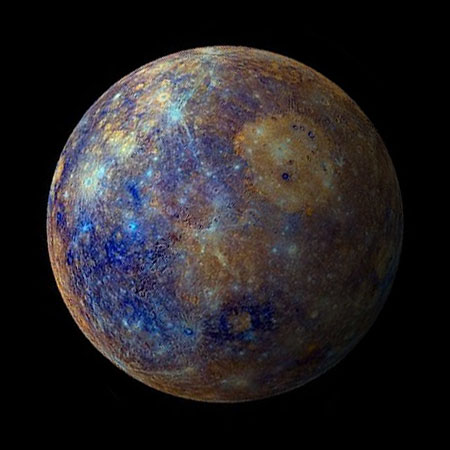
Although Mercury is a close neighbour, we know very little about it. Sky & Telescope is now regularly announcing the imaging of planets around stars beyond our Solar System, yet we have only photographed about half of Mercury, and that was a quarter of a century ago!
Mercury is a very strange planet, so strange that it challenges the classical model of planet formation. It is not very big; smaller than Mars, a bit bigger than our own Moon, and about the size of Jupiter’s Moon Callisto. However, it has a huge Fe-Ni core, much bigger than predicted by classical planetary formation theory. Planetary geologists have struggled to understand this huge core. Some have suggested that a gigantic collision ripped off a once much thicker mantle, or that heat from the Sun volatilised the outer layers of the planet during the early days of the Solar System. These are intriguing theories, but the crust of Mercury today is made of anorthosite, the same material as the crust of Earth’s Moon, and the stuff that primitive crust should be made from according to classical planetary formation theory. The bottom line is that theories involving removal of the mantle to account for the size of Mercury’s core don’t account for Mercury’s normal crust and, quite frankly, planetary geologists are stumped on this one!
Table of Contents
What about Mercury’s surface features: how normal or abnormal are they? Well, it’s a bit of both! For example, the Caloris Basin on Mercury is a giant multi-ring Impact Basin just like the Orientale Basin on the Moon. However, even this seemingly normal structure is rather odd because of the “Weird Terrain” that occurs on the opposite side of the planet. “Weird Terrain” is an amazing jumble of hills, some up to 10 km across that look as though the planetary surface was fractured, thrown upwards and then dropped down to form a sort of crazy-paving made of gigantic blocks of crust. Nothing like it exists anywhere else in the Solar System. Planetary geologists think it has something to do with Mercury’s huge Fe-Ni core, which is so big compared to the planet as a whole that it channeled the shock waves from the Caloris impact and focused them on the other side of the planet. This created an incredible rebound effect that formed the “Weird Terrane”: something that would not happen in a “Rocky Planet” with a normal size core. Another feature that is unique to Mercury is the presence of enormous scarp (cliff) faces, 100’s of km long by up to a km high that formed when the abnormally large core cooled with time. As the core cooled, it shrank, and as it shrank -because of its relatively large size – it forced the outer surface to contract as well, giving rise to large, curved shrinkage cracks that we can see on the surface of the planet. Because these shrinkage cracks cut across many large impact craters, we know that they are younger than the Great Bombardment, that’s to say, younger than 3.8 Ga.
Mercury Geology of an Enigmatic Neighbor
Planetary science has progressed by leaps and bounds in the past few years: we’ve sent probes to all the outer planets, except for Pluto, our detailed photographic coverage of Mars from orbiting probes is almost as good as our coverage of Earth, we’ve now detected over 100 extra-solar planetary systems, and we’re only a few steps away from actually imaging them. So it’s ironic that Mercury, a planet we can see with the naked eye for much of the calendar year, is so poorly imaged, so poorly known, and its planetary geology is so poorly understood.
All the images we have of Mercury come from the unmanned Mariner Missions of the mid-1970’s, principally Mariner 10 in 1974_75. Mariner 10 made three fly-bys, though because of the orbital mechanics of the probe and the planet, Mariner always saw the same hemisphere illuminated by the Sun. This means that we have no images of 50% of one of our nearest planetary neighbors.
The orbital mechanics of Mercury are unique among the planets, but very similar to those of the moons of the outer Solar System. Because Mercury is so close to our star, the Sun exerts an enormous gravitational pull, raising powerful tidal forces within the rocks that make up the planet. The result is that Mercury’s rotation around its own axis has slowed down to synchronize with its orbit around the Sun, such that it now takes two complete orbits around the Sun to complete thee rotations about its own axis.
In other words, there are three Mercurian days for every two Mercurian years! We only discovered the rotational behavior of Mercury in the 1960’s thanks to radar beamed from Earth. Before that, visual observations from Earth produced some very crude maps of the planet’s surface: crude, and mostly imaginary, like the example from the mid-1930’s by the Greek astronomer Antoniadi.
In terms of its size, Mercury lies somewhere between Mars and our own Moon: in fact it’s exactly the same size as Jupiter’s moon Callisto. However, from studying the effect of the gravitational pull of Mercury on the Mariner probes, planetary scientists calculate that Mercury is almost as dense as its much larger neighbors, Earth and Venus. This presents planetary geologists with a difficult conundrum: in order to be small and dense, Mercury must contain a very large, very heavy core of iron and nickel that spans 75% of its diameter.
The problem is that theory says that planetary bodies form by the clumping together or accretion of smaller bodies made of primitive meteoritic material (chondrite) that heats up and differentiates into a core, a mantle and a crust. When primitive chondritic material differentiates, it yields a much smaller amount of iron and nickel relative to the size of the planet certainly not 75%. So what’s the explanation? Two principal theories have been proposed to account for the anomalously large Mercurian core, but neither of them work! Some planetary geologists suggest that the heavy bombardment by meteorites during the accretionary phase of the early Solar System smashed the outer layers of a once much larger Mercury, leaving a core and a thin relic mantle behind.
Others suggest that, because Mercury formed so close to the early Sun, its outer layers were volatilized by the energy pumped out by the star at the centre of the evolving early Solar System.
The problem is that, by analyzing the light reflected from the planet, we know that the surface of Mercury is made of the same stuff as the surface of our own Moon: a rock called anorthosite that has a composition similar to CoffeeMate, and a calcium aluminum silicate called plagioclase feldspar. This is exactly the rock that planetary science predicts should form the primitive crust.
In other words, while Mercury may be anomalously heavy on the inside, it is perfectly normal on the outside. So whatever the explanation for the anomalously large core turns out to be, it apparently has nothing to do with stripping off the external layers of a once much larger planet, which is most unfortunate, because current planetary theory doesn’t offer us any other explanations!
Comparisons with Earth’s Moon
So what does Mercury’s surface look like? Superficially, surface features on Mercury resemble those on Earth’s Moon, with heavily cratered terrains versus flatter, smoother plains. Not only does Mercury have one of the largest giant Impact Basins in the Solar System— Caloris Basin, some 1300 km in diameter— but superficially it looks just like the huge Orientale Impact Basin that is mostly hidden from us on the west side of the Moon. But, when you look a bit more closely, the apparent similarities between Mercury and the Moon give way to differences. Perhaps the biggest difference is the way the cratered and smooth terrains are distributed. On the Moon, the smooth terrains are the dark Mare that are sharply delimited from the lighter heavily cratered Highlands. This color difference reflects the fact that the dark Mare are made of basalt lava that occurs all over the side of the Moon that always faces the Earth, while the light colored Highlands are made of anorthosite (the CoffeeMate rock). However, on Mercury the Smooth Plains (as they are officially called) are all concentrated in one place: they form the floor inside the Caloris Impact Basin, and a collar around its perimeter. In contrast to the lunar Mare, the Smooth Plains on Mercury are the same color and therefore the same composition as the Heavily Cratered Terrain. Therefore, some planetary geologists have suggested that they are not made of lava, but are formed of fine-grained debris derived from the impact that made the Caloris Basin. However, by measuring the number and size of impact craters, the Smooth Plains are not only relatively young in the history of Mercury, but they are much younger than the impact that made the Caloris Basin.
Hence, whatever the Smooth Plains are really made of, they did not form during the major impact event that sculpted the surface of Mercury as we see it today. Another major contrast between the Moon and Mercury is that unlike the Moon, Mercury has a second set of flat terrains called the Inter-Crater Plains. These plains are impacted by lots of craters and are therefore relatively old, but right next door the same Inter-Crater Plains can flood and drown other impact craters, so the plains are relatively young. The obvious conclusion here is that the Inter-Crater Plains formed during the Heavy Bombardment, about 4 billion years ago another major difference with the Moon. AstroNotes August/September 2003 What about the impact craters themselves? Superficially, they look just like those of the Moon, with central peaks, flat floors and terraced walls characteristic of the larger examples. However, the transition to these mature crater forms occurs at smaller sizes on Mercury, the stuff thrown out of the hole by the impact didn’t travel as far from the crater as on the Moon, and the bright rays associated with the larger impact craters are better preserved on Mercury.
Some planetary geologists attribute these differences between lunar and Mercurian craters to the greater gravity of the planet due to its large, dense core, however others contest both the measurements and the conclusion. Hence, we arrive once again at a stalemate in planetary science!
Other, uniquely Mercurian impact craters formed when meteorites struck the planetary surface while it was hot and, like toffee, too weak to support the topographic contrast between high-standing crater walls and a deep crater floor. Hence, these craters seems to have flattened out almost as soon as they formed, something else that we do not see on the Moon.
Planetary Shrinkage and a Giant Impact There are two more major features on the Mercurian surface that we do not see on the Moon, or any other rocky planet for that matter. The first is a series of curved escarpments, hundreds of kilometres long, and more than a kilometre high. These are structures that formed as the planetary surface contracted during a period when the large iron-nickel core of Mercury cooled and shrank. They always cut across the impact craters, so they must be younger than the Heavy Bombardment. Remember that means younger than 3.8 billion years old. The other feature unique to the Mercurian surface is called “Hilly and Lineated Terrain,” better known as Weird Terrain.
This double-ringed impact crater seems to have sunk back into the surrounding terrain.
An example of “weird terrain.” random hills (whose slopes have gradients of up to 50%) that represent a localized upheaval that lifted the surface of the planet and dumped it down again in a random jumble of hills and depressions.
This Weird Terrain only occurs in one place, precisely on the other side of the planet from the Caloris Impact Basin. The accepted interpretation is that the giant impact that created the Caloris multi-ringed Impact Basin sent shock waves through the entire planet that converged on the opposing hemisphere, jumbling the surface with no preferred orientation. The terrain includes several rift valleys, like the Ottawa Valley here on Earth. The Dark Side Clearly there are lots of questions regarding the planetary geology of Mercury that we cannot answer with the information we have in hand today. Another unmanned mission is required, but will it happen anytime soon?
Meanwhile, radar images from Earth have revealed a bright spot some 500 km across in the unknown hemisphere that could be a giant volcano like those found on Mars, and the same radar images show bright spots at the Mercurian poles that are currently interpreted as ice. That’s pretty remarkable for a planet whose maximum surface temperature at perihelion rises to about 500°C!
As an amateur astronomer, I am very excited by the discoveries currently being made regarding extra-solar planets, and the new-found moons of Jupiter and Saturn, but somehow we seem to have forgotten one of our nearest planetary neighbors; a neighbor that throws up a whole series of questions regarding our most cherished theories of how planets form. Perhaps it’s time to send another probe.