Odale-Articles-Manicouagan
IMPACT CRATER EXPLORATIONS
by: Charles O'Dale
MANICOUAGAN IMPACT STRUCTURE
|
1 The passage of the shock wave through the rock changes the structure of some of the enclosed minerals. IE: change is possible in the feldspar mineral plagioclase. The shock wave can break down the structure of the mineral, changing parts of it into a diapletic glass (glass formed at high-pressure in the solid-state) which is isotropic, or uniform in all directions. This photograph of a thin slice of plagioclase, 0.03 millimetre thick, is seen here in cross-polarised light, with a 'sensitive tint' plate. The original plagioclase is coloured yellow and the shock-changed mineral is purple. This sample is from the Manicouagan impact structure. (Courtesy Denis W. Roy & MIAC).
2 Maskelynite: A type of naturally occurring glass having the composition of plagioclase series feldspar, created by the vitrification of plagioclase by shock melting in meteorites and meteorite impacts. |
|
This map (LEFT) dated from the 1960’s illustrates the recent disposition of the geology and of the lakes around the Manicouagan impact structure. The two arcuate lakes, Mushalagun and Manicouagan, do indicate an impact structure signature.
Recently, the completion of the Manicouagan Dam (RIGHT) filled the annular moat to its present depth creating a circular reservoir for hydro-electric power. This circular lake accentuates the contour of the eroded impact-brecciated ring area of the structure. But the diameter of the original crater was approximately three times the size of this moat. |
MANICOUAGAN MORPHOLOGY
Approximately 214 million years ago an estimated 10 kilometre wide hypervelocity meteorite impacted at between 12 and 30 kilometres per second and formed the Manicouagan Impact Structure. The resultant 100 kilometre diameter Manicouagan crater is one of the largest impact craters still preserved on the surface of our planet. For comparison, the Copernicus crater on the moon has a diameter of 93 kilometres and the annular moat of the Manicouagan structure would fit comfortably within the rim of this lunar crater.
At the point of impact, the country rocks were instantaneously evaporated/melted/shattered by the energy released leaving a 200 to 600 cubic kilometre sheet of impact melt directly on basement rocks. The target rock in the vicinity of the structure is Grenville age amphibolite to granulite facies quartz and feldspar gneiss, with local anorthosites, metagabbro and metasediments overlain by Ordovician limestones, dolomites, slates and sandstones. The force of the impact exhumed and liquefied these target rocks down to as deep as 9 kilometres. The original crater became a melting pot for relatively young rocks at the surface and for much of the older minerals originally buried kilometres below the site of the impact. The heat released was so intense that it took between 1,600 and 5,000 years before the melted rocks cooled. Changes in these impactite textures toward the interior of the crater progressively increased in proportion of superheated melt and decreased in fraction of cold fragmented country rock material (Simonds 1976).
Outer Circumferential Depression, Outer Disturbed Zone and Inner Fractured Zone
Inner Plateau
The Inner Plateau of the Manicouagan structure is bounded by the annular moat, overlain by melt sheet, underlain by shocked basement rock (Orphal, Schultz 1978). We found a "lunar landscape" here containing various breccia types. The astronauts exploring the moon found that impact-melt breccias, similar to what we found here, were the most common rock types at the Apollo highland sites (Apollos 14, 15, 16 and 17) (Haskin 1998). We documented impact breccias formed by similar and very different country rocks like those found on the moon!
Central Region
|
The Central Region of the Manicouagan Structure is a complex zone of uplifted, shocked and metamorphosed basement rocks with small tabular bodies of impact melt and pseudotachylite veins (Orphal, Schultz 1978). Recent U-Pb zircon dating of the impact melt gave an age of 214 ± 1 million years.
This impact melt cliff (RIGHT) and talus (debris at the base of the cliff), found in the central region area of the Manicouagan Impact Structure, is composed of target rock that was made temporarily molten from the energy released during impact. There are not any detectable meteorite components in the Manicouagan structure melt rock (Palme et al., 1978). I tried to climb the talus slope up to the cliff face but it became very unstable the higher I climbed. I got to the point that I was creating dangerous rock slides without making any progress. I stopped to take this picture; looked down and found the "Manicouagan shatter cone" (illustrated below). An odd feature is in one of the impact melt cliffs in Memory Bay (LEFT). A 10 m block of mafic gneiss (indicated in the image) is suspended about 20 m above the base of the melt sheet. Such a block is 0.3g/cm³ denser than the melt and should settle at a minimum of 5 cm/sec (Stokes Law1) through a Manicouagan composition melt with 2% H2O (water) if it were still liquid at 1000°C. In order for that block to remain suspended, the melt must have begun to crystallize rapidly enough to trap the block before it settled to the bottom of the sheet (Simonds 1976). |
1 STOKES LAW: If the particles are falling in the viscous fluid by their own weight due to the Earth's gravity, then a terminal velocity, also known as the settling velocity, is reached when this frictional force combined with the buoyant force exactly balance the gravitational force. The resulting settling velocity (or terminal velocity) is given by:
Vs = ( 2 (ρp - ρf ) / 9 η ) g R2 where:
- Vs is the particles' settling velocity (m/s) (vertically downwards if ρp > ρf, upwards if ρp < ρf ),
- R is the radius of the spherical object (in metres),
- g is the Earth's gravitational acceleration (m/s2),
- ρp is the mass density of the particles (kg/m3),
- ρf is the mass density of the fluid (kg/m3), and
- η is the fluid's viscosity (in [kg m-1 s-1]).
The Manicouagan impact may not have had a significant effect on life. No extinctions are recorded at the documented time of impact, 214 million years ago.
The impact did trigger a powerful seismic event as Lawrence Tanner from Bloomsburg University recently discovered in a deformed zone of the Fundy Rift Basin. "There have been previous reports attempting to link paleoseismicity, as recorded by soft-sediment deformation features, to impacts," Tanner explained. "But this is the first instance of linking the Manicouagan impact to the stratigraphic record. I made the association between the impact and paleoseismicity in the Fundy Rift Basin, a sedimentary basin 700 km away from the impact site, and went looking for shocked quartz grains. Finding them allows us to place this impact into a stratigraphic context and look elsewhere to see if there are any significant biotic effects. So far, there don't seem to be any." The Fundy rift Basin experienced a substantial period of volcanic activity at the time of the Manicouagan impact.
|
The fireball generated by the impact probably expanded as far as the present location of New York City. The impact also triggered powerful seismic events and ejected material out of the atmosphere. The ejected material was sent on a ballistic trajectory around the earth. Like the Chicxulub impact, the Manicouagan impact left behind a global geochemical signature in the rock record. In an article published today (November 14, 2002) in the journal Science researchers led by Dr. Gordon Walkden of Aberdeen University have reported the discovery of a 214 million year old impact layer in the rocks of the west of England. The 2 cm thick layer consists of millimetre-sized green spherules that were formed as molten droplets of rock in the impact of a large asteroid or comet with the Earth. The droplets formed by condensation from gasses generated by vaporisation of rocks at enormous temperatures and were scattered over the entire Earth surface.Julian Parker, from Aberdeen, studied the spherule layer with Walkden and discovered quartz grains that had been deformed by intense pressures. “The orientation of the distorted planes through the grains showed they had been shocked,” said Walkden, “and proves the layer was formed as debris thrown out from a giant collision.” Dr. Simon Kelly, from the Open University, measured the age of the spherule layer using the decay of radioactive potassium that is found in all potassium-bearing minerals. The age of 214 million years is the same as the 100 km wide Manicouagan impact structure in Canada which is, therefore, the likely source of the impact layer. Kelly, however, suspects that a number of craters that have similar ages may have formed the same time as a string of impacts. Walkden, Kelley, Parker, Thackrey (2006), THE ANATOMY OF A NEW IMPACT DEPOSIT: THE LATE TRIASSIC SPHERULE LAYER, SW. ENGLAND European Space Agency: [SELECTED QUOTES]The documented late Triassic spherule layer of SW England deposit (illustrated here) contains an abundance of spherules, common shocked quartz and a suite of accessory minerals believed to have been derived direct from the impact site. These include garnets, ilmenites, zircons and biotites. Garnets and ilmenites are highly fractured, and biotites show prominent kink bands indicative of shock. The time of the deposit was determined by noting the decay of radioactive potassium in the spherule layer and dates at 214 ± 2.5Ma. This is comfortably within the date of the late Triassic Manicouagan impact event.Single grain K-Ar ages for the biotites are in the range 700-1100Ma which are superficially similar to the Grenville rocks around the Manicouagan impact site. Given the geometry of the contemporaneous Triassic continental assembly, the contact point of the impactor was only 20 crater diameters from the site of deposition of this ejecta layer. |
Aerial Exploration
|
I approached the impact structure from the west and here the airplane is directly over the area of the “outer disturbed zone” (image left). In the two times that I have visited Manicouagan the weather unfortunately compromised the quality of my pictures. You can see the low cloud layer over the central uplift region in the center of the structure with a rain squall in the southern area. The immensity of this impact structure is astounding. The image from left to right spans over 70 km! At the cruising speed of my aircraft it would take over 15 minutes to cover that distance.
The southern area of the annular moat (image right) illustrates the overwhelming size of the moat that was once filled with impact-brecciated rock. The kinetic energy required to create this amount of impact-brecciated rock took less than a millisecond. In the distance over the central plateau you can see the central uplift and the impact melt area. |
On the south shore of Memory Bay (image right) is a flat plateau of impact melt which is terminated by a cliff. This feature is visible just off the wing of the airplane near the shore. The hills of the central uplift are visible in the background.
|
Over Memory Bay (image left) looking south west is the central uplift feature visible in the foreground with the south west section of the annular moat visible in the background. This area is what remains of the original central peak of the complex multi-ringed crater.
At this point (image right) the airplane is flying over ground zero of the impact looking south. The central peak of the uplift feature of the crater is in the foreground. The 400 m central peak is actually 5 km offset from the center of the crater. A depression, visible in the near background, is at the physical center of the crater. The south shore of the annular moat is visible in the far background. |
| This image (right) is taken from directly over the central peak. Looking east from here is Memory Bay which is visible in the near background with the north east section of the annular moat visible in the background. If you were standing here 214 million years ago you would most certainly be having a very bad day! |
Manicouagan Impact Structure Ground Expedition - 2006
|
My ground exploration of impact structures continued in August of 2006 when Eric Kujala and I explored the east area of the Manicouagan Impact Structure by canoe. At this point I want to strongly recommend AGAINST exploring this body of water by canoe. The weather in this area changes within minutes creating dangerous waves in the annular moat (see below), and being in a canoe that is full of rocks in those conditions is not a good idea!
Superimposed on this Manicouagan Structure map are the areas we explored. The canoe route is indicated here by the white lines and the ground explorations are indicated by the red lines. The numbers indicate locations of interest. We paddled over 80 kilometres by canoe in our three and a half days of exploration. |
|
During our drive north to the Manicouagan structure I specifically watched the changing rock faces along the road as we entered the area of the 100 kilometre diameter structure. In the inner fracture zone of the structure, some of the rock faces along the highway changed from solid granite faces to fractured walls (LEFT). These rocks were fractured by an impactor 214 Million years ago about 40 kilometres away from this spot!
Note the rock structure that is mostly breccia free gneiss here (RIGHT) on the eastern outside section of the annular moat at location #1. As a result of the Manicouagan impact, molten rock and dust from this bedrock left a thin layer of glass beads and shattered mineral grains in a rock deposit in the United Kingdom. Dating of this UK deposit connected it to Manicouagan precluding most of the European impact sites nearby as the source of the deposit layer. We had a short wind delay here before we made our dash for the main island of the structure that is just visible in the image over 10 km away. At the time this picture was taken, the wind was subsiding with barely a whitecap to be seen. |
| We got half way across before the wind increased again. Fortunately, by that time we were in the lee of the couple of islands visible in the distance. Paddling against the wind took us most of the day to finally reach our main island camp location. The shock breccia deposits illustrated here are from (left) location #2 and (right) location #3 but are typical for almost every rock face on the shore of the main island. To my knowledge, there are no breccia deposits like this on the outside of the annular moat. Impact breccias are made up of fragments of the target rocks, containing various ratios of impact melt and shocked mineral inclusions. |
|
At location #3 I also noticed a possible shock pseudotachylite vein in the breccia outcrop. The colour of the breccia filled rocks around Memory Bay varied from white to copper (illustrated here) to dark-mafic. Pseudotachylite is formed when a high pressure, caused by an earthquake or a meteorite impact, is applied to a rock and abruptly released. This causes the rock to partly melt along the points of sudden movement.
From location #3 we had a hard uphill slog against the wind to the shock impact melt cliff on the south shore. We eventually made it to the south shore where I walked to the impact melt cliffs shown here at location #4. This is as close as I could get to the cliff as the steep slope of the cliff talus made footing very untenable.
|
I mentioned earlier that it is not recommended to do this trip by canoe (as we did). The waves on the annular moat and in Memory Bay can reach dangerous heights very quickly. On our final day in the impact structure we were returning to our starting point in Kauashapishkau Bay in a semi-calm wind. But within 20 minutes the wind had increased from under 10 kts to greater than 30 kts! We had to perform an emergency beaching on an island 1/3 of the way across the annular moat.
|
I took this image minutes after we performed the emergency beach landing at location #5. The canoe, visible on the beach in the background, is 18 feet long and a glance at the waves behind the canoe gives you an appreciation of the size of the waves we navigated through! We made it onto the beach by surfing the waves! It was fortunate that Eric was an experienced white water canoe operator, as we may have otherwise been dumped. Here, we had just started a fire to dry ourselves off. We will be marooned here for 22 hours waiting for the winds to subside. We eventually made it off the island at 5AM the next morning. Within 15 minutes of waking up during a wind lull, we had struck camp and were paddling for dear life! We made it back across the reservoir without incident in under three hours. We had a great tail wind. What an adventure!!
It was surreal later that morning eating our hot egg and bacon breakfast in a restaurant and realizing that just hours ago we were marooned without any idea of how long it would be until we could get back to the main land. |
Manicouagan (added September 2010)
from (AstroNotes October 2010;)
Approximately 214 million years ago an estimated 10 kilometre wide hypervelocity meteorite impacted at between 12 and 30 kilometres per second and formed the Manicouagan Impact Structure.
|
|
![]() |
The resultant 100 kilometre diameter crater (image left - Courtesy NASA/LPI) is one of the largest impact craters still preserved on the surface of our planet. The Copernicus crater on the moon (image right - Courtesy NASA - A12) has a diameter of 93 kilometres. For comparison, the Manicouagan's annular moat would fit comfortably within the rim of the Copernicus Crater.
Morphological elements of the Manicouagan structure are based on topographical expression and are:
- outer circumferential depression - ~150-km outer diameter;
- outer disturbed zone - ~150 km diameter;
- inner fractured zone - ~100 km outer diameter;
- annular moat - ~65 km outer diameter;
- inner plateau - ~55 km outer diameter;
- central region - ~25 km outer diameter. (Grieve, Head 1983)
In the summer of 2006, Eric Kujala and I explored the interior of the Manicouagan impact structure by canoe and on foot. We entered the structure from the east, crossing the all these morphological elements and concluding in the Memory Bay inlet. This inlet is on the east portion of the island forming the central peak of the structure. To read about our harrowing experience while in the crater please see my web site about the trip (O'Dale 2006).
At the point of impact, the country rocks were instantaneously evaporated/melted/shattered by the energy released leaving a 200 to 600 cubic kilometre sheet of impact melt directly on basement rocks. We observed changes in these impactite textures as a progressively increasing proportion of superheated melt and a decreasing fraction of cold fragmented country rock material toward the interior of the crater (Simonds 1976). The following images will illustrate these observations.
Outer Circumferential Depression, Outer Disturbed Zone and Inner Fractured Zone
In Part IV of this series I documented the shattered rock we encountered at approximately 40km from the central peak as we entered the outskirts of the crater. We did could not identify the outer circumferential depression.
Peripheral Trough
The water filled circular annular moat that is prominent in space images is only one third of the size of the original crater. The water in the annular moat fills a ring where impact-brecciated rock was eroded away by glaciation. Before flooding of the reservoir, isolated outcrops of tilted and deformed limestone, siltstone and shale were found on the inner edges of the moat (Murtaugh, 1975).
This rock formation is found at the extreme eastern portion of the annular moat on one of the small islands. Note the rock structure is breccia free gneiss. The central peak of the structure is visible over 10 km in the distance.
Inner Plateau
The Inner Plateau of the Manicouagan structure is bounded by the annular moat, overlain by melt sheet, underlain by shocked basement rock (Orphal, Schultz 1978). We found a "lunar landscape" here containing various breccia types. The astronauts exploring the moon found that impact-melt breccias, similar to what we found here, were the most common rock types at the Apollo highland sites (Apollos 14, 15, 16 and 17) (Haskin 1998). We documented impact breccias formed by similar and very different country rocks like those found on the moon!
Impact breccias were melted, mixed, crushed and compressed by shock waves at various stages in the cratering process: (1) during the initial shock-wave expansion and transient crater formation; (2) during the subsequent modification of the transient crater. Even within the brief formation time of an impact crater, it is possible for the multiple generations of breccia to develop and to produce distinctive differences, even though the time between one breccia generation and the next may be measured in seconds or minutes (French 1998). The extremely small size of the grains within the matrix between the country rock fragments were formed by the very high pressure of the gas generated when the bolide impacted.

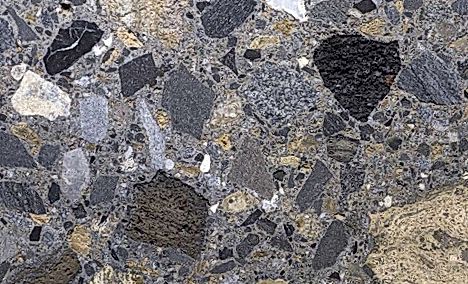
This photo illustrates a breccia outcrop found within the inner plateau area of the Manicouagan Impact Structure. Note the different types of rock fragments forming the breccia within the fine grained matrix impact melt.
This images documents "uniformly white" shattered country rocks imbedded in a fine grained matrix impact melt. This breccia outcrop is found in an inlet, cut into the central peak of the impact structure, known as Memory Bay.
Further west into Memory Bay I noticed a possible shock pseudotachylite vein within a breccia outcrop. The pseudotachylite veins associated with impacts are much larger than those associated with faults and are thought to have formed by frictional effects within the crater floor and below the crater during the initial compression phase of the impact and the subsequent formation of the central uplift. In Part IV of this series I illustrated the pseudotachylite found in the Sudbury Impact Structure. Impact related pseudotachylite was first recognized at the Vredefort crater in Africa.
Central Region
The Central Region of the Manicouagan Structure is a complex zone of uplifted, shocked and metamorphosed basement rocks with small tabular bodies of impact melt and pseudotachylite veins (Orphal, Schultz 1978). Recent U-Pb zircon dating of the impact melt gave an age of 214 ± 1 million years.
The illustrated impact melt cliff and talus (debris at the base of the cliff) is found in the central region area of the Manicouagan Impact Structure. It is composed of target rock that was made temporarily molten from the energy released during impact. There are not any detectable meteorite components in the Manicouagan structure melt rock (Palme et al., 1978).
I tried to climb the talus slope up to the cliff face but it became very unstable the higher I climbed. I got to the point that I was creating dangerous rock slides without making any progress. I stopped to take this picture; looked down and found the "Manicouagan shatter cone" I documented in Part VI of this series. Serendipity at its best!

While we explored the impact melt cliffs on the north shore of Memory Bay we noticed an odd feature in one of the cliffs. Eric took this image of the feature. It shows a 10 m block of mafic gneiss (indicated in the image) suspended about 20 m above the base of the melt sheet. Such a block is 0.3g/cm³ denser than the melt and should settle at a minimum of 5 cm/sec (Stokes Law) through a Manicouagan composition melt with 2% H2O (water) if it were still liquid at 1000°C. In order for that block to remain suspended, the melt must have begun to crystallize rapidly enough to trap the block before it settled to the bottom of the sheet (Simonds 1976).
Conclusion
Documented in this article were impact metamorphic rocks found in the Manicouagan impact structure to illustrate shock metamorphism in an impact crater. Separately, each of these shock metamorphic features could be explained by naturalistic means (other than impact), but taken together they strongly suggest evidence for an impact. Similar rock formations found in other craters and will be documented in future articles.
The Triassic-Jurassic Extinction - Impact? (Smith 2011)
| Scientists reported in the journal Nature today (March 13, 1998) that they had found evidence of a chain of five craters formed 214 million years ago that was likely due to pieces of a comet crashing into the Earth's surface, similar to the Comet Shoemaker-Levy 9 impact on Jupiter in 1994. The craters no longer appear to be in a straight line due the shifting of the Earth's continents due to plate tectonics. Two of the craters, Manicouagan and Saint Martin, are in Canada (Quebec and Manitoba, respectively). The other three craters are Rochechouart in Europe, Obolon in the Ukraine and Red Wing in Minnesota. The impacts appeared to occur at the Norian stage of the Triassic period, about six million years after a mass extinction that wiped out 80% of all the species on Earth, but the ages of all the craters are uncertain enough to include this extinction (from ScienceWeb Daily). |
Summary of impact structures in the Late Triassic.
|
Abstract: The 34-million-year (My) interval of the Late Triassic is marked by the formation of several large impact structures on Earth. Late Triassic impact events have been considered a factor in biotic extinction events in the Late Triassic (e.g., end-Triassic extinction event), but this scenario remains controversial because of a lack of stratigraphic records of ejecta deposits. Here, we report evidence for an impact event (platinum group elements anomaly with nickel-rich magnetite and microspherules) from the middle Norian (Upper Triassic) deep-sea sediment in Japan. This includes anomalously high abundances of iridium, up to 41.5 parts per billion (ppb), in the ejecta deposit, which suggests that the iridiumenriched ejecta layers of the Late Triassic may be found on a global scale. The ejecta deposit is constrained by microfossils that suggest correlation with the 215.5-Mya, 100-km-wide Manicouagan impact crater in Canada. Our analysis of radiolarians shows no evidence of a mass extinction event across the impact event horizon, and no contemporaneous faunal turnover is seen in other marine planktons. However, such an event has been reported among marine faunas and terrestrial tetrapods and floras in North America. We, therefore, suggest that the Manicouagan impact triggered the extinction of terrestrial and marine organisms near the impact site but not within the pelagic marine realm (Onoue, Tetsuji, October 2012). |
The Triassic-Jurassic Extinction - Volcanic?
References
M.H.L. Deenen, M. Ruhl, N.R. Bonis,W. Krijgsman, W.M. Kuerschner, M. Reitsma, M.J. van Bergen, A new chronology for the end-Triassic mass extinction. Earth and Planetary Science Letters 2009.
Dence, M. R. 1976 The Manicouagan impact structure. NASA Spec. Pub.
French, Bevan M. 1998. Traces of Catastrophe, A handbook of Shock-Metamorphic effects, Lunar and Planetary Institute.
Grieve and Head, 1983. R.A.F. Grieve and J.W. Head, The Manicouagan impact structure: An analysis of its original dimensions and form.
Haskin, L et al 1998, The case for an Imbrium origin of the Apollo thorium-rich impact-melt breccias. Meteoritics & Planetary Science, vol. 33, no. 5, pp. 959-975.
Murtaugh, J.G. 1972, Shock metamorphism in the Manicouagan cryptoexplosion structure, Quebec. Proc. 24th Int. Geol. Congr.
O'Dale, C.P. 2006; Manicouagan Impact Structure
Tetsuji Onouea, et al; Deep-sea record of impact apparently unrelated to mass extinction in the Late Triassic. Rutgers University/Lamont-Doherty Earth Observatory, Palisades, NY, October 3, 2012
Orphal, D & Schultz, P, An alternative model for the Manicouagan impact structure. Proc Lunar Planet Sci Conf 1978.
Simonds, C.H. et al 1976, Thermal model for impact breccia lithification: Manicouagan and the moon. Proc. Lunar Sci. Conf. 7th (1976) p. 2509-2528.
Smith, R. Dark days of the Triassic: Lost world - Did a giant impact 200 million years ago trigger a mass extinction and pave the way for the dinosaurs? NATURE 17 Nov. Vol#479 2011.
Notes
- PHOTOGRAPHIC IMAGES: Eric Kujala and Charles O’Dale.